

Los padres de familia están llamados a apoyar a sus hijos e hijas a enfrentar las diversas situaciones y emociones que pueden estar afectandolos como consecuencia de la cuarentena y medidas preventivas frente al COVID-19. Ahora más que nunca es cuando los niños, niñas y adolescentes requieren atención, cuidado, compañía y mucho amor.
En víspera de la celebración del Día del Padre, UNICEF quiere destacar el papel de los hombres en el desarrollo y el bienestar de los niños, niñas y adolescentes durante la cuarentena por COVID-19, así como fomentar en ellos su rol como padres en la crianza compartida con las madres, destacando sus responsabilidades en todos los procesos de formación, comunicación, diálogo y participación en el hogar.
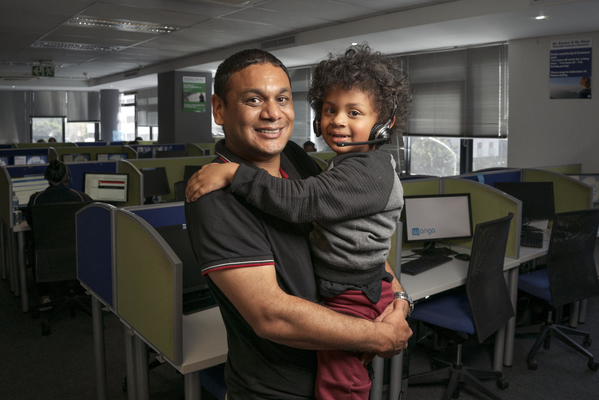
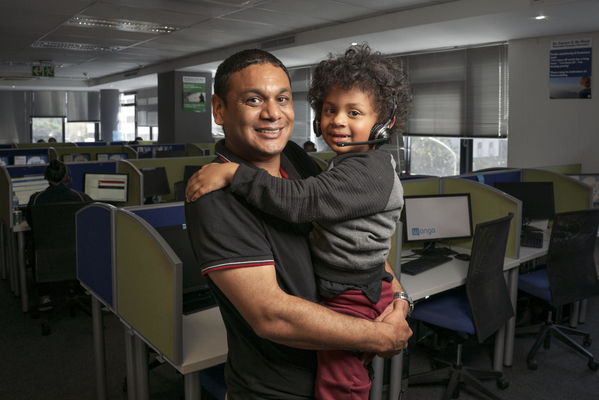
Fahiem Abrahams, 37, holds his son Fawad, 4, for a portrait taken at the Wonga call centre where Fahiem works in Cape Town, South Africa on 7 May 2019. Fawad, who lives with autism, communicates primarily through musical intonation rather than words. “For someone who’s non-verbal, he’s very vocal,” Fahiem says. “A year and a half ago he was basically mute. Now anything he says is music to my ears. He sings all the time, but I can’t make out what he’s saying.” In January 2019, Fawad began attending Alpha School for Learners with Autism. In the months since then, he has made tremendous strides forward, passing developmental milestones that his parents worried he might never reach. While Fawad’s enrollment at Alpha School has been a life-changing event, it has also created new challenges for the family. The school is located far from Fahiem’s office and his family’s home, requiring a two-hour commute each morning. But Fahiem says that “just being there for your kids” is the most important part of being a dad. Fawad, age 4, wanders into the room, his thick mop of long, loose curls swaying with each small footfall, with a melodic string of sounds tumbling from his smiling lips. “For someone who’s non-verbal, he’s very vocal,” says Fawad’s father, Fahiem Abrahams, 37. “A year and a half ago he was basically mute. Now… he sings all the time, but I can’t make out what he’s saying.” Fawad, who lives with autism, is the middle of three children. His family lives in Bonteheuwel, Western Cape, South Africa. “If you go to an autism workshop, you’ll see three fathers and 40 mothers,” Fahiem says. “I don’t know why fathers are so disengaged.” Taheera, Fahiem’s wife, interjects: “Fathers struggle to accept (autism), where mothers have no choice but to accept. It’s a maternal value to accept, where fathers don’t want to give up their dreams.” Fahiem nods his head in agreement.At first, Faheim and Taheera felt helpl 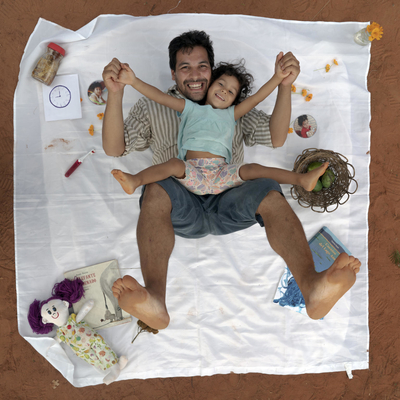
Rafael Alfonso Araujo, 27, poses for a portrait with his daughter Selva, 2, on a blanket outside their home in Areguá, Central department, Paraguay’ on 28 January 2019. Selva attends Torore, a UNICEF-supported âcreative and cultural center» that was launched by the Central Department government as a model Early Childhood Development (ECD) centre.Rafael and his wife, Luma, 28, run an independent bakery and sell homemade baked goods to contractors tand nearby government offices. Surrounding Rafael and Selva are items that represent some of the things their family have come to learn about, and are able to provide, thanks in part to Torore. Rafael says that the program has had a deeply transformative effect on the way that he and Luma are raising their family. Fatherhood has shattered my preconceptions â helped me unlearn that the father is a provider and the mother is the care-giver. It hasnât been easy to break down those roles. Also, putting my childrenâs needs foremost âlearning to put my own needs second⦠Itâs been quite a journey building a new person from the young man I was, and becoming a father.â Washing sticky hands after peeling a mango for his childrenâs breakfast, Rafael, 27, speaks excitedly about Torore, the Early Childhood Development (ECD) day care centre that Selva, 2, and Amaru, 3, attend. âTorore fit our family like a ring on a finger; it opened at the moment when we decided to make our own lifestyle.â Rafael and his wife, Luma, 28, run a small, independent bakery that provides homemade food items to government workers in Areguá, not far outside the Paraguay’s capital city, Asunción. The family of four live in a rural home that Rafael and Luma built by hand, and they work hard to maintain a lifestyle that keeps them in close contact with the land and leaves a small ecological footprint. âWe donât have a car, we have a bike. Thatâs how we move around town and sell our baked goods,» Rafael says. «Everyone in AreguÃ
Son varias acciones en las que el padre de familia puede participar con sus hijos e hijas para que conjuntamente puedan llevar de la manera más amigable, tranquila y afectiva esta coyuntura. Ahora más que nunca es cuando los niños, niñas y adolescentes requieren atención, cuidado, compañía y mucho amor. Una de estas es mantenerse tranquilos, con escucha activa, tener conversaciones calmadas y asertivas con los hijos e hijas, en las que ellos se sientan protagonistas y escuchados. En esta situación de pandemia por el COVID-19, es clave que los hijos encuentren en sus padres todo el apoyo para sobrellevar cualquier dificultad, incertidumbre o preocupación a través del diálogo, explicándoles sobre el momento actual que atraviesa el mundo, tranquilizándolos y generando espacios de aprendizaje, distracción y juego a través de actividades compartidas.
Durante esta pandemia los padres deben ayudar a sus hijos e hijas con la definición de rutinas y hábitos saludables que les permitan sentir y expresar sus emociones, adquirir autonomía, responsabilidad, disciplina y orden. A pesar de los momentos difíciles, es bueno que el padre de familia aproveche para explicar que los miedos y temores que genera la cuarentena son normales y que estos sentimientos y sensaciones deben ser expresados y van a pasar.
Es necesario tener paciencia ante los comportamientos de angustia y estrés de sus hijos e hijas y reaccionar de forma afectiva y comprensiva, enseñando con ejemplos las formas apropiadas de relacionamiento con los demás y entendiendo que estas son reacciones normales dentro de la coyuntura actual.
Durante este periodo, es importante priorizar acciones simples y cotidianas, darles cariño y amor, garantizarles una alimentación saludable y buenas prácticas de higiene, cambiar los pañales, jugar, cantar, bailar, pintar, leer un cuento y propiciar una buena actividad física, entre otras.
Involucrarse en las tareas del hogar y la crianza en relaciones de igualdad, compartiendo responsabilidades de forma respetuosa y no violenta es la mejor manera de crear ese entorno protector en el hogar que todos los niños y las niñas merecen.
“Tanto el papá como la mamá contribuyen y representan un estímulo único e importante para que los niños y niñas desarrollen vínculos positivos emocionales y cognitivos esenciales, desde muy temprana edad para su buen desarrollo cerebral y aprendizaje. Ser papá es un privilegio y conlleva una gran responsabilidad, ¡por eso en este día queremos destacar su labor!”, manifiesta la Representante de UNICEF Colombia, Aida Oliver.















Discussion about this post